⚫ Black or brown spots
Dark spots or lines in the grooves of back teeth. Some are just stains, some are decay. A dentist can tell the difference.

A black spot, a rough hole your tongue keeps finding, food getting stuck, or a twinge with sweets: these are signs of tooth decay. Most cavities don’t hurt until they’re deep, so the earlier you get it checked, the smaller the treatment.
Decay often starts where you can’t see it: in the grooves of back teeth and between teeth. Look out for:
Dark spots or lines in the grooves of back teeth. Some are just stains, some are decay. A dentist can tell the difference.
A pit your tongue keeps finding, a rough edge, or a piece of tooth breaking off around an old filling.
A short sharp pain when you eat something sweet, or with cold water or ice cream.
Food keeps catching in the same place between two teeth. Often a sign of a cavity between them.
Dull white spots near the gum line are the very first stage, when decay can still be stopped without a filling.
A bad smell from one area that doesn’t go away with brushing, sometimes from food trapped in a cavity.
Illustration: decay spreads inward from the enamel (1–2) through the dentine (3) to the nerve (4), and can lead to an infection at the root tip (5).
The difference between stage 2 and stage 4 is often just a year or two of waiting. That’s why a painless cavity is worth treating now.
“I was very scared… The treatment was painless and felt completely effortless.”
“He explained the procedure clearly and treated me with great care.”
“Wonderful and painless treatment… for my daughter's root canal.”
Short excerpts from public Google reviews, without names. Read all reviews on Google.
Enamel has no nerves. Decay can eat through it, and well into the dentine, without any pain at all. By the time a cavity hurts, it’s usually close to the nerve.
So “no pain” doesn’t mean “no problem”. A black spot or a hole that doesn’t hurt is the cheapest and simplest time to fix it.
We show you the tooth on the intraoral camera, and a digital (RVG) X-ray shows decay between teeth and how deep it goes. You decide with the full picture.
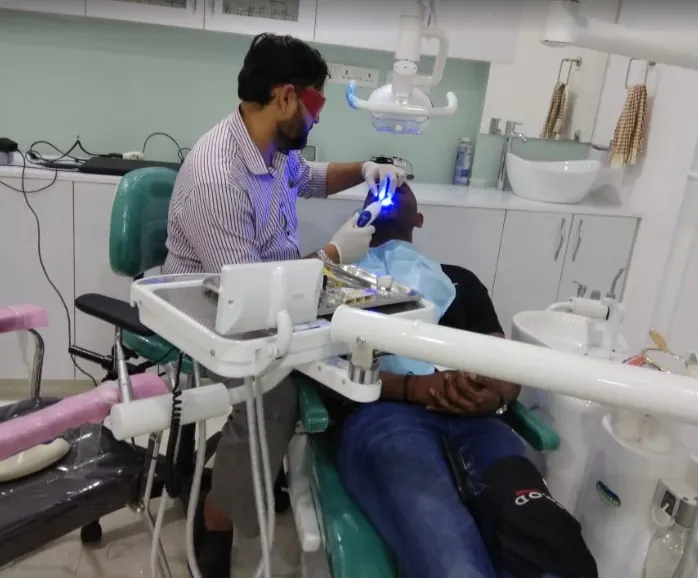
Bacteria in plaque turn sugar into acid, and the acid dissolves the tooth. How often you eat sugar matters more than how much.
Sweet tea and coffee through the day, biscuits, juices and sticky snacks keep teeth under acid attack for hours.
Brushing doesn’t reach between teeth. Without floss, decay starts there and only shows on an X-ray.
Old fillings and crowns can leak at the edges, and decay starts again underneath.
Saliva protects teeth. Some medicines, mouth breathing and dehydration reduce it.
Exposed roots are softer than enamel and decay quickly near the gum line.
Milk or juice at bedtime and frequent sweets cause fast decay in milk teeth.
The aim is the smallest treatment that lasts.
Fluoride, sealing deep grooves and diet advice can stop a white-spot lesion from becoming a hole.
The decay is removed under local anaesthetic and the tooth rebuilt with a filling that matches its colour.
When decay has weakened a large part of the tooth, a crown protects it from cracking. Crowns & cosmetic work
If decay reached the nerve, root canal treatment saves the tooth instead of removing it. Root canal guide
A tooth too broken down to repair is removed gently, and the gap can be filled with an implant or bridge.
A check-up every six months catches new cavities early. The Annual Plan includes two cleanings a year.
Not every dark spot needs drilling, and not every cavity needs a root canal. In 26 years on Hutchins Road, Dr. Farooq (BDS, FAGE, with a professional diploma in endodontics) has built his practice on telling patients plainly what their tooth needs, and treating it gently.
You get direct access to Dr. Farooq, see the problem on screen, and get a written plan before any treatment.
More about Dr. FarooqWhatsApp us what’s bothering you (a photo or old X-ray helps), or call 099455 39225. Calls are answered 9 am–9 pm, every day.
We’ll offer a slot that suits you (Mon–Sat, 10 am–2 pm or 5 pm–8:30 pm) and tell you if anything is needed beforehand.
Ground Floor, 42 Hutchins Road, Frazer Town / Cooke Town. Bring old X-rays or reports and a list of any medicines you take.
Tooth decay (dental caries) is the process of acid dissolving the tooth. A cavity is the hole that decay leaves behind. Early decay can be stopped before a cavity forms; once there’s a hole, it needs a filling.
Enamel has no nerves, so decay can grow without pain until it nears the nerve. A painless cavity is the best time to treat it: the filling is smaller and the nerve is still healthy.
No. Tea, coffee, tobacco and some foods stain the grooves of teeth without decay. A dark spot that’s soft, rough or growing is likely decay. We check with the camera and, if needed, an X-ray.
Only at the earliest white-spot stage, before there’s a hole, with fluoride and less sugar. Once a hole has formed, the tooth can’t grow back, and the cavity will keep growing until it’s filled.
Yes. Decay can start again at the edge of an old filling or crown, especially if it’s leaking or chipped. Regular check-ups catch this early.
Deep decay in a back tooth can cause pain that spreads to the head, ear or jaw. Food and bacteria trapped in a cavity can also cause bad breath. Both settle once the tooth is treated.
A typical filling is done in one visit, usually 30–45 minutes. The area is numbed first, so you feel pressure but not pain. 21 of our Google reviews describe treatment as painless.
Yes, and it spreads quickly in milk teeth. Bring your child in at the first dark spot or complaint. Milk teeth hold space for adult teeth, so saving them matters. Avoid milk or juice at bedtime and limit sweets between meals.
Yes. Fillings are safe in pregnancy, and the middle three months are the most comfortable time. Tell us how far along you are.
It depends on the size and the material. We don’t publish price lists. You’ll get a written quote before treatment, and the consultation is free if you go ahead with treatment.
Ground Floor, 42 Hutchins Road, Frazer Town / Cooke Town. Mon–Sat, 10 am–2 pm and 5 pm–8:30 pm. Calls answered 9 am–9 pm.